
CMT: A European Congress to Unite and Accelerate Research
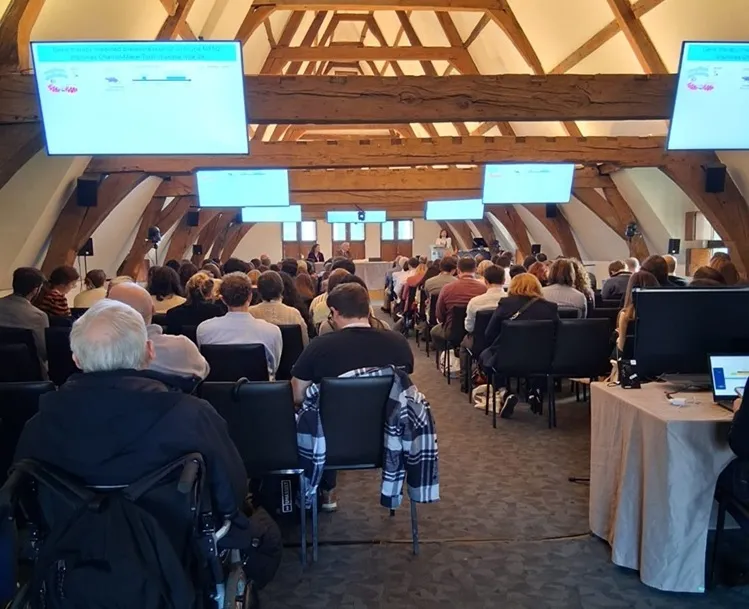
Antwerp put the spotlight on CMT by hosting the second European congress dedicated to Charcot-Marie-Tooth disease. The event strengthened cooperation across Europe among researchers, clinicians and patients. Discover the key highlights: promising treatments and diagnostic innovations.
Charcot-Marie-Tooth disease (CMT) was the focus of a unique event, a European congress dedicated entirely to the condition, held in Antwerp (Belgium) from October 23 to 25. Nearly 140 key stakeholders including researchers, clinicians, patients, industry representatives and policymakers came together for three days. Jointly organized by the ECMTF (European CMT Federation) and the ECRA (European Charcot-Marie-Tooth Research Association), and supported by AFM-Téléthon, the event reaffirmed a central ambition: turning scientific progress into tangible solutions for affected families.
Toward Stronger European Cooperation in the Fight Against CMT
From the outset, the congress emphasized the need for coordination at the European level. ECRA, founded after the first European congress in 2023, reached an important milestone by electing its first official board. It includes representatives from science, medicine and the patient community. France will be represented by Nathalie Bernard-Marissal, a researcher at the University of Marseille, Gorka Fernandez-Eulate, a neurologist at the Institute of Myology, and Alexandre Hoyau, president of CMT-France.
The association will coordinate efforts across Europe to engage industry in developing new treatments, facilitate the secure sharing of health data to improve diagnosis, and make patients true partners in the research process.
Structures such as the ENMC, which has already organized nearly ten workshops dedicated to CMT, and the EURO-NMD network, which brings together expert centers from across Europe, show that significant opportunities exist for collaboration, knowledge sharing and accelerating medical advances in partnership with ECRA.
From Diagnostics to Treatment Pathways: A Wealth of Advances
On the diagnostics front, several presentations demonstrated the value of long-read sequencing technologies. These allow for a much deeper analysis of DNA and the detection of complex genetic anomalies such as inversions or triplet repeat expansions that traditional sequencing methods often miss. Two newly identified genes, DARS2 and PIGB, may be linked to rare forms of CMT, and early findings were shared from the first diagnosed families.
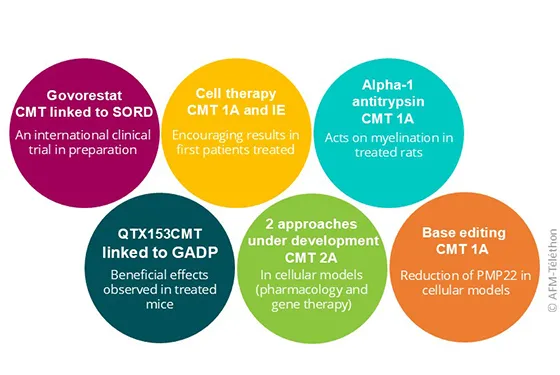
Promising Therapeutic Strategies Highlighted
Six Research Projects Honored for Their Contributions to CMT
To honor Daniel Tanesse, former president and co-founder of the European CMT Federation and a driving force behind the creation of ECRA, six awards in his name were presented to three oral presentations and three scientific posters.
- One study showed that Schwann cell membranes lack cholesterol due to a protein called ABCA1. Blocking this protein using PSC-833, an experimental molecule, restored Schwann cell function and improved motor performance in mouse models of CMT1A (K. Kuipers).
- A team from the Institut de Myologie demonstrated that certain mutations in the PIGB gene may cause a predominantly motor neuropathy beginning in childhood, characterized by stiffness and muscle weakness (G. Fernández-Eulate).
- A new experimental model developed with support from AFM-Téléthon, using human stem cells, enables a more precise study of interactions between nerves, Schwann cells and muscle cells. It could become a more reliable tool for understanding myelination and assessing future treatments (B. Bekaert).
- Another study suggested that macrophages, immune cells that remove damaged cells and pathogens, behave differently in CMT1A. These changes may influence disease progression by affecting Schwann cells, opening new avenues for future therapies (M. Van Brussel).
- Nanoparticles capable of delivering gene therapy agents directly into Schwann cells were designed. Preliminary results suggest this approach is safe but requires further optimization to enhance its effectiveness (A. Kagiava).
- Finally, research showed that in CMT1A, Schwann cells abnormally release cathepsin, contributing to worsening nerve damage. Blocking this activity could slow disease progression and offer new therapeutic strategies (K. Libberecht).
Technology at the Service of Patient Care
Several speakers highlighted the growing role of new technologies. These include motion sensors, smartwatches, mobile apps, secure telemedicine platforms, smartphone-integrated cameras, computers or tablets, and virtual reality. These tools are becoming increasingly accessible and offer new opportunities to improve access to care in underserved areas, engage patients in their rehabilitation and monitor treatment outcomes during clinical trials.
Sources
- 2nd European CMT Specialist Conference : University of Antwerp website – watch the recorded presentations and access the full conference program
- Uniting Science & Community: the 2nd CMTSC : ECMTF website – watch the video presentations